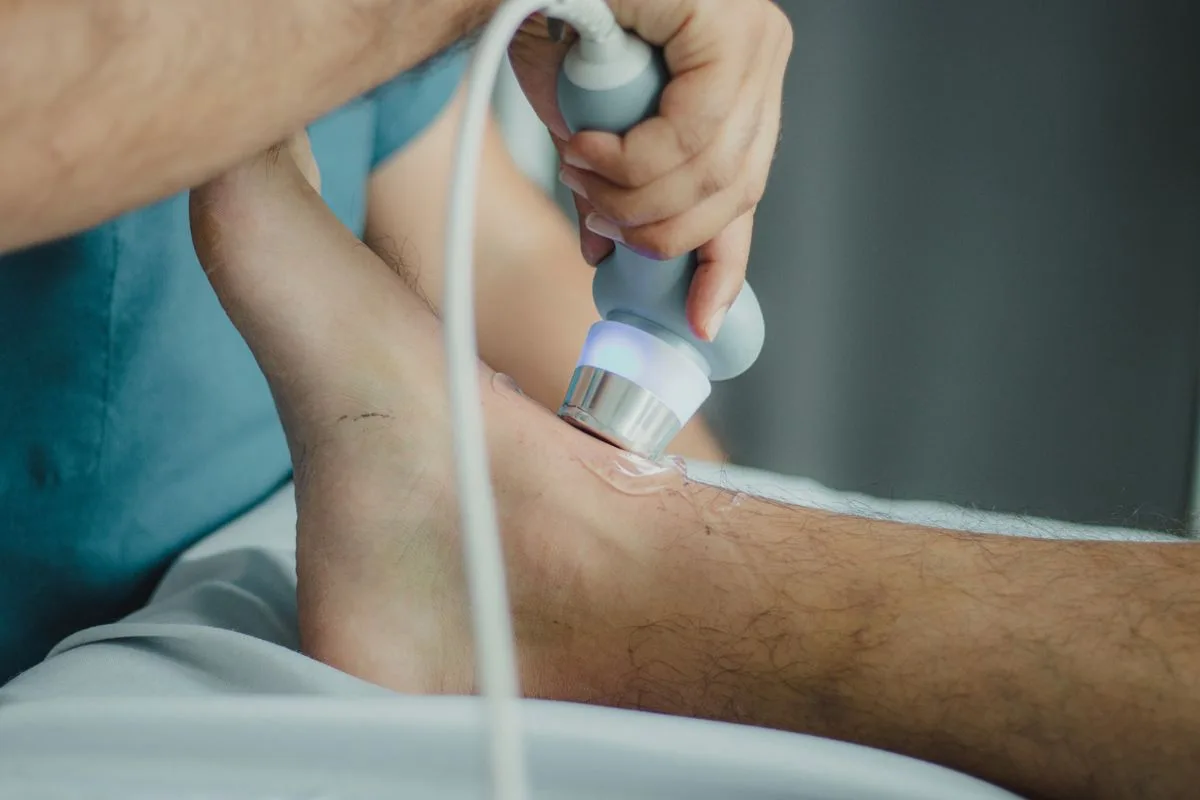
When Achilles pain has stalled despite rest and exercise, shockwave therapy can be a useful addition to a good rehab plan. Here is how it works and who it suits.
Medically reviewed by Dr. Natalie Tilton, PT, DPT, Owner of Ability Allies · Published

The Achilles tendon connects your calf muscles to your heel bone. Achilles tendinopathy is a painful, irritated tendon that has been asked to handle more load than it can currently tolerate, usually through repetition rather than a single injury. It is common in runners and other active people, but it also shows up in people who are not especially athletic.
Typical signs include:
Tendinopathy can affect the middle of the tendon or the point where it attaches to the heel, and the two areas can respond a little differently to exercise. Our pages on tendinitis and foot and ankle pain cover the broader picture.
Rest alone rarely fixes a tendon. Tendons adapt to load slowly, over weeks and months, and they need progressive loading to rebuild their capacity. For Achilles tendinopathy, that usually means a structured calf-strengthening program that gradually builds from what you can tolerate today toward the demands of your activity, along with adjustments to training volume, footwear, and the activities that flare it.
Early on, that may mean calf raises at a load and range that keep pain manageable while the tendon is irritable. Over the following weeks the program typically progresses toward heavier, slower calf work, and then toward the springy, faster loading that running and jumping require. Mild discomfort during exercise is often acceptable as long as it settles and your morning stiffness is not getting worse over time. Your therapist will help you find that line.
For many people, a well-guided loading program is enough. Some tendons, though, plateau. Months go by with the same morning stiffness and the same pain after activity, even with consistent exercise. That is where shockwave therapy may come in.
Shockwave therapy is an add-on for stubborn Achilles pain, not a replacement for strengthening. It works best as part of a plan that also rebuilds the tendon's capacity to handle load.
Shockwave therapy, more formally extracorporeal shockwave therapy, uses focused acoustic pressure waves delivered through a handheld applicator. Despite the name, these are not electrical shocks. They are pulses of mechanical energy that pass through the skin into the target tissue.
That controlled stimulus is thought to prompt a renewed healing response in tissue that has stopped progressing on its own, including increased blood flow and new collagen activity. Achilles tendinopathy is one of the chronic tendon conditions where shockwave tends to be used, alongside plantar fasciitis, tennis and golfer's elbow, and calcific shoulder tendinitis.
Research on shockwave for Achilles tendinopathy has been encouraging, particularly when it is combined with an exercise program, but responses vary from person to person. No single treatment can guarantee a result, and your therapist will tell you honestly whether it makes sense for your situation.
Shockwave therapy is not appropriate during pregnancy, over an implanted pacemaker, over an active growth plate in a child or teenager, or in an area with a known blood clot or tumor. Tell your therapist about these and any other medical conditions or medications before your first session. When you are ready to find out whether shockwave fits your plan, you can request an appointment.
Seek prompt medical care if you have:
Also let your doctor know if Achilles pain began after starting a new medication, since certain antibiotics have been linked to tendon problems.
Dr. Natalie Tilton earned her Doctorate of Physical Therapy from Northeastern University and has spent over 15 years in the field, practicing across orthopedics, post-surgical recovery, sports rehabilitation, aquatic therapy, pediatrics, and pulmonary rehab. She is certified in the Hesch Method, Graston Technique, Dry Needling, Kinesiotaping, CranioSacral Therapy, Cupping, and Custom Foot Orthotic Casting, and she is the owner of Ability Allies. Read Dr. Tilton’s full bio →
Achilles care at Ability Allies combines a progressive loading program with options such as shockwave therapy when a tendon has plateaued, plus sports rehabilitation to get you back to running and training.
We see patients at our Portsmouth physical therapy clinic, Dover clinic, and Epping clinic. Call (603) 770-0408 to ask about shockwave therapy and find the right location for you. No referral needed in New Hampshire.