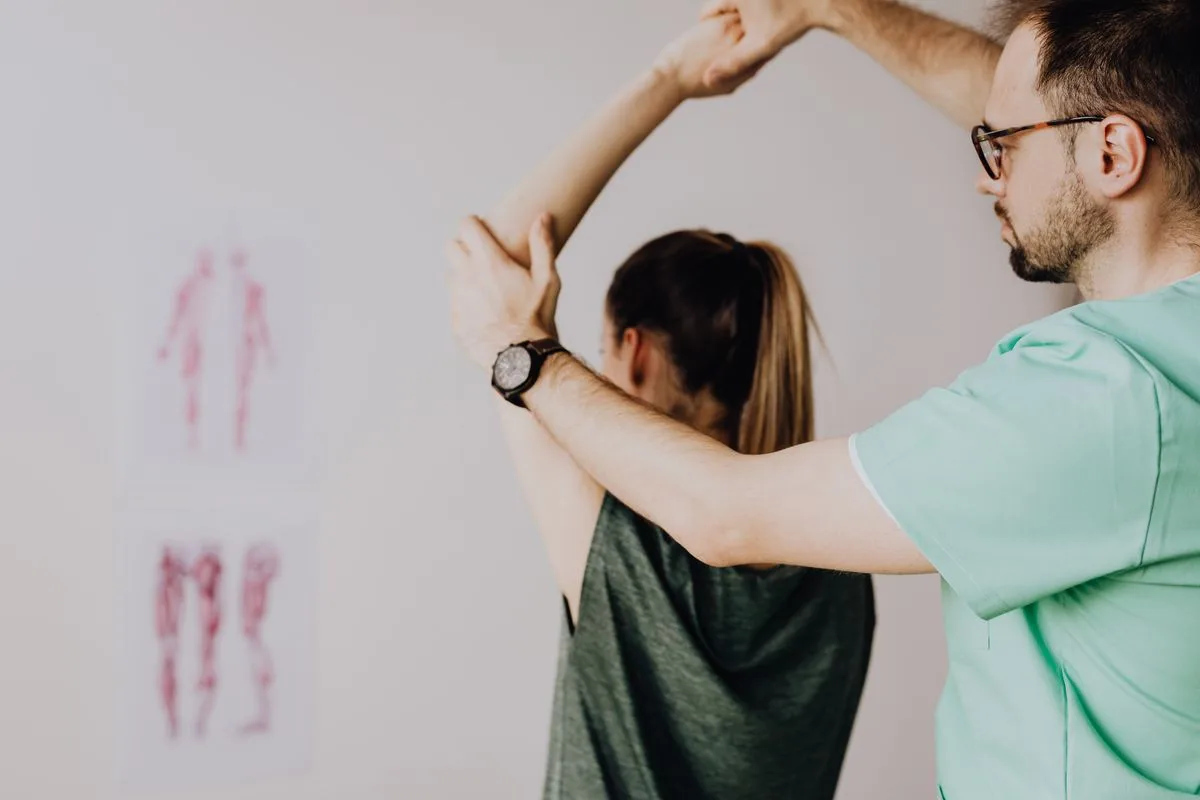
Reaching overhead or sleeping on that side has become painful. If your shoulder pain is limiting what you can do, one evaluation opens the door to full mobility again.
The shoulder is the most mobile joint in your body, which means it depends heavily on muscle strength and control to stay stable. When the rotator cuff muscles weaken, the surrounding muscles tighten, or your posture tips the joint out of alignment, pain follows. Understanding what has changed in your shoulder mechanics is the key to relief that lasts.

The rotator cuff is a group of four small muscles that stabilize your shoulder. They can be strained from overuse or torn from an injury or fall. Pain with overhead movement or lying on that side is the telltale sign. Some small tears heal well with the right movement and strengthening. Larger tears may need more intervention, but building strength around the injury helps either way.
Frozen shoulder is stiffness that comes on gradually and limits your range of motion. It often follows an injury or period of immobility. The connective tissue around the shoulder tightens down, making movement painful and restricted. Physical therapy breaks up that stiffness and restores movement through gentle stretching and mobilization.
When the rotator cuff muscles are weak or fatigued, the head of the humerus shifts upward slightly, pinching the tendons and bursa underneath. This impingement causes sharp pain with overhead reaching. Opening up the space and strengthening the muscles that control the joint is the fix.
The acromioclavicular joint sits at the top of your shoulder. Arthritis, sprains, or misalignment can cause pain, especially with overhead movement or across-the-body reaches. Improving the mechanics of the shoulder often reduces or eliminates AC joint pain without needing advanced treatment.
Spending hours at a desk with rounded shoulders or doing repetitive overhead work loads the rotator cuff without adequate recovery. The muscles fatigue and tighten. Over time they strain or tear. Improving your posture and how you load your shoulder prevents injury and stops existing pain from getting worse.
Your shoulder stability depends on muscles working in coordination. If some muscles are weak and others are overactive, the joint becomes unstable and painful. Rebalancing and strengthening these muscles restores stability and gets you back to pain-free movement.


We start by assessing your shoulder's movement, stability, and strength. We use hands-on techniques to release tight muscles and improve mobility. We address any movement restrictions in your shoulder blade and neck that are affecting how your shoulder works. Then we build strength and control in the rotator cuff and supporting muscles. We teach you how to move and exercise in a way that keeps your shoulder healthy. The goal is not just less pain. It is a shoulder strong enough to handle reaching, throwing, sleeping, and all the activities that matter to you.
We test your shoulder's range of motion, strength, and stability. We check how your shoulder blade moves and how your posture affects your shoulder. We look for what has changed in your mechanics. You leave with a clear understanding of what is causing your pain and how we will fix it.
We use hands-on work to release tight muscles and restore normal shoulder movement. We improve mobility in your shoulder joint and shoulder blade. Pain decreases as the joint works better and compression is reduced.
We rebuild the rotator cuff and supporting muscles. We teach you exercises that strengthen your shoulder without causing pain. We show you how to move, reach, and work in ways that protect your shoulder long-term.
Shoulder pain that has lasted for months often involves the rotator cuff tendons, which need progressive strengthening rather than more time off. If a specific tear has been diagnosed, see rotator cuff tears. For long-standing tendon pain, including calcific tendinitis in the shoulder that has plateaued with exercise, shockwave therapy may be an option alongside your strengthening program. Pain that spreads from the neck into the shoulder blade or arm is assessed together with the neck, because the source is not always the shoulder itself.
Shoulder or arm pain that comes with chest pain, shortness of breath, sweating, or jaw pain can be a sign of a heart problem: call 911. Sudden inability to lift your arm after a fall, or a shoulder that looks deformed, should be seen urgently.
Julia exceeded my expectations. I was nervous because I've never had PT. She made me feel so comfortable.
Shoulder care combines manual therapy and dry needling with rotator cuff strengthening in physical therapy, shockwave therapy for calcific or stubborn shoulder tendon pain, and sports physical therapy for overhead athletes.
We see patients for shoulder pain at our Portsmouth, NH clinic, Dover, NH clinic, and Epping, NH clinic. No referral needed in New Hampshire.

Shoulder problems often affect how your arm and wrist work. Treating the whole chain restores full function.

The shoulder is a complex joint that benefits from whole-system assessment and treatment.

Shoulder injuries are common in throwing and overhead sports. Real recovery means strength and control that lasts.