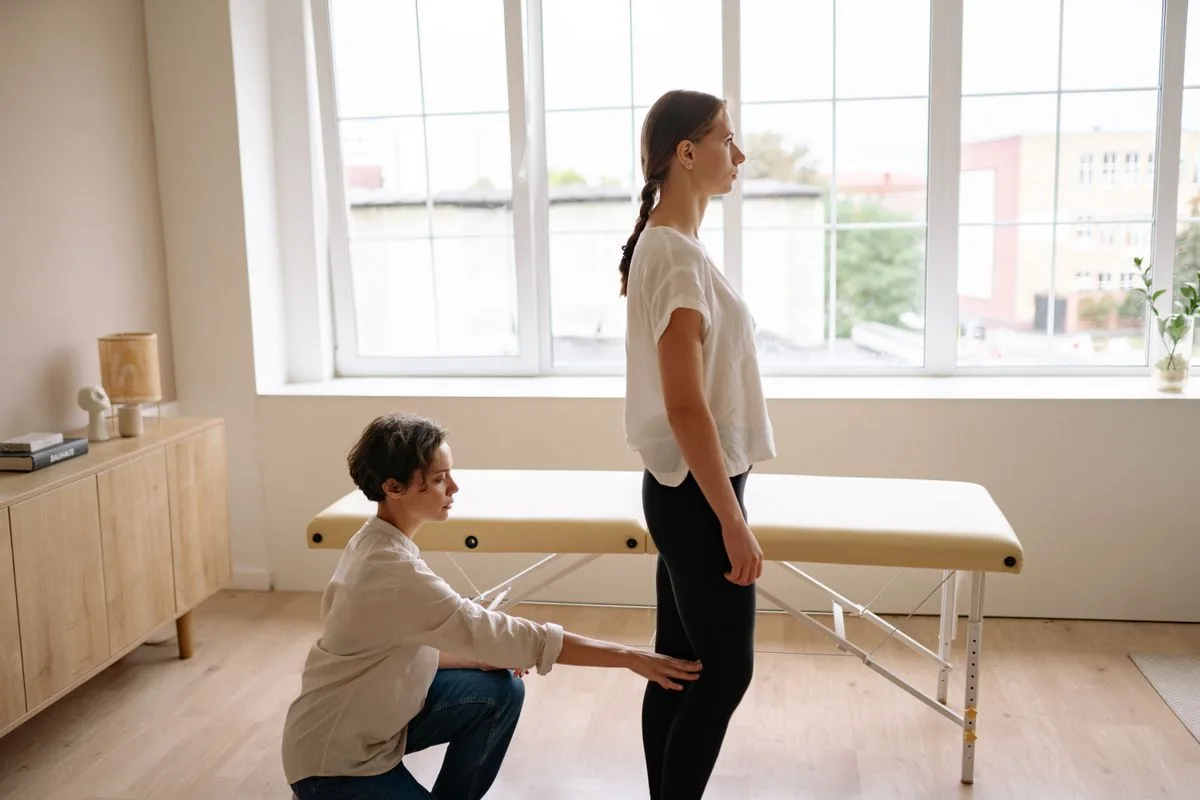
Postural Realignment corrects what years of desk work, driving, and phone use have quietly reshaped in your spine, before that pattern turns into tomorrow's chronic pain.

Postural Realignment is a targeted approach to correcting the muscle imbalances that pull your body out of its natural alignment over time. Posture is not a matter of willpower or simply remembering to sit up straight. It is the product of which muscles have gotten strong and tight from overuse and which have gotten weak and lengthened from underuse, day after day, for years. Hours at a desk shorten the muscles across the front of your chest and hips while the muscles across your upper back and glutes go quiet, pulling your head forward, your shoulders round, and your pelvis out of neutral. Postural Realignment starts with an assessment of how you actually stand, sit, and move, identifying which muscles are driving the pattern rather than just treating whichever spot currently hurts. From there, treatment combines targeted stretching for the tight, overactive muscles with strengthening for the weak, underactive ones, along with movement retraining that teaches your body new default positions. The goal is not a single correction in the clinic. It is changing the pattern your body returns to by default, so the improvement holds up under a full day of real life.
Lasting postural change depends on identifying the actual imbalance driving your specific pattern, since two people with what looks like the same rounded posture can have completely different muscles at fault. A therapist trained in postural assessment reads these patterns through movement screening and observation, then builds a plan around what your body specifically needs rather than a generic exercise sheet. This is also why postural work should be flagged if you have a diagnosed structural condition like significant scoliosis, so treatment accounts for what can and cannot realistically change, and sets expectations accordingly from the very first visit.

Postural Realignment is for anyone whose daily habits have quietly reshaped how their body holds itself. These are the patterns we see most often.
Hours hunched toward a screen have pulled your head forward and your upper back into a rounded curve. We retrain the muscles that pull your head back over your shoulders, easing the neck and upper back strain that builds through a normal workday and tends to worsen the longer it goes uncorrected.
Your shoulders roll forward no matter how many times you try to pull them back. Postural Realignment loosens the tight chest muscles holding them there and strengthens the mid-back muscles that are supposed to hold them in place instead, so the correction stops requiring conscious effort.
An anterior pelvic tilt from tight hip flexors and a weak core quietly increases the curve in your low back and the strain that comes with it. We correct the imbalance at its source instead of only chasing the pain it creates day after day.
Postural Realignment sessions combine assessment, hands-on work, and retraining. Here is how a typical plan comes together.
Your therapist observes how you stand, sit, and move, identifying which muscles are tight and which are weak. This mapping is what points treatment at the actual source of your pattern instead of just the spot that currently hurts.
You work through targeted stretches for the overactive muscles and strengthening for the underactive ones, specific to the imbalance found in your assessment. This combination is what actually shifts a posture that stretching alone tends to leave unchanged.
Your therapist teaches you new default positions for sitting, standing, and moving through your day, along with simple cues to catch the old pattern before it resets. This is the step that makes the change last outside the clinic.
Postural change takes consistency over a single session, so expect a progressive plan rather than an instant fix. Let your therapist know about any diagnosed structural condition, such as significant scoliosis, so your program is built around what is realistic for your spine.
Relief. I found relief here. Reverse lordosis with severe foraminal narrowing pinched the nerve, causing significant pain.
Postural realignment pairs with manual therapy and an ergonomic assessment when your workday is part of the problem. Common reasons patients ask about it:
Ask about postural realignment at our Portsmouth NH physical therapy clinic, Dover NH clinic, or Epping NH clinic. One-on-one care, same-week evaluations, and no referral needed in New Hampshire.

Hands-on joint mobilization and soft tissue work that pairs well with postural correction.

Fine needles release stubborn muscle knots and calm pain, restoring motion when tight tissue holds you back.

Comprehensive approach to pain that often has a fascial component at its root.